This guide is for Townsville four-wheel drivers setting up or fixing a dual battery system for camping, fishing trips and outback drives. It covers the choices that matter most in North Queensland conditions, where heat, dust, corrugations and long distances test every connection.
Sponsored
Your auto electrical business, front and centre in Townsville
This spot is shown to people looking for auto electrical help anywhere in Townsville. See sponsor spots and prices.
How can we help?
Need it fixed?
Find a local 4WD and Dual Battery Setups for North Queensland auto electrician for anything from a flat battery to a full fit-out.
Find an auto electricianBuying parts?
Quality auto electrical parts from Ozautoelectrics, an established Australian supplier since 2010, dispatched through a nationwide network. For retail and trade buyers.
Shop partsDoing it yourself?
Free step-by-step guides written for Queensland conditions, with the parts you’ll need listed for each job.
Browse DIY guidesAuto electrician in 4WD and Dual Battery Setups for North Queensland?
Are you an auto electrical business? List your business on this site.
List your business on this siteWhat North Queensland asks of a 4WD electrical system
A typical weekend out of Townsville might mean a run up the Hervey Range Road, a few days on a dirt track with the fridge running, and a drive home in the heat with the air conditioning flat out. Longer trips head west along the Flinders Highway, where towns are far apart and help can be a long way off.
Those trips are hard on a 12V system in three ways. Heat shortens battery life and makes chargers and alternators work harder. Corrugations shake every terminal, bracket and crimp. And fine dust gets into fuse boxes, switches and plugs. A setup that works fine in the driveway in Deeragun can start failing a few hundred kilometres in.
How a dual battery system works, in short
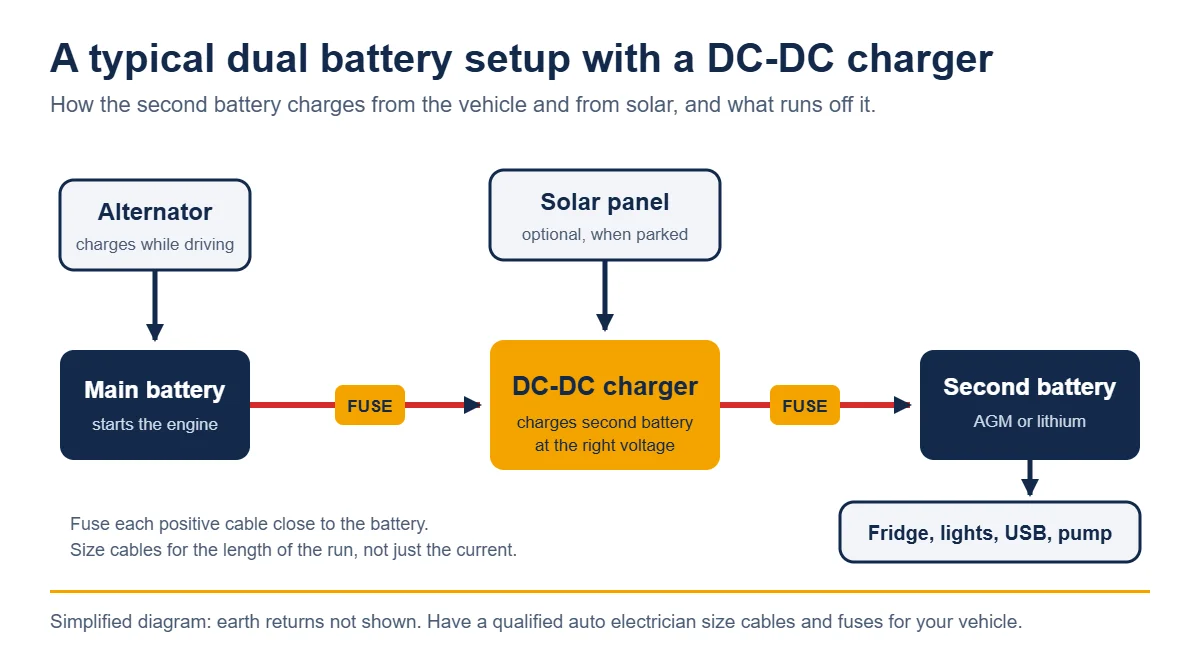
The idea is simple. Your starting battery stays reserved for starting the engine. A second, auxiliary battery runs the fridge, lights, radio and other camping gear. Something has to charge the second battery from the vehicle while you drive, and stop the two batteries draining each other when you're parked.
That something is either a voltage sensitive relay (an isolator) or a DC-DC charger. Our guide on how a dual battery system works covers the basics in more detail.
Advertisement
DC-DC charger or isolator for newer 4WDs
Many recent four-wheel drives have a smart or variable voltage alternator. It lowers the charging voltage once the starting battery is reasonably full, to save fuel. That's fine for the starting battery, but a simple isolator then passes on a voltage that may be too low to fully charge a second battery, especially one mounted in the tub at the end of a long cable run.
A DC-DC charger fixes this by boosting and controlling the voltage to suit the auxiliary battery's chemistry. Many also accept a solar input. For older vehicles with a fixed voltage alternator and a second battery close by, an isolator can still do the job. Read our guides on smart alternators and on choosing a DC-DC charger or isolator before you buy.
Where to put the second battery in the heat
Under the bonnet is the traditional spot, but engine bays in North Queensland get very hot, and heat is hard on batteries of every type. Lithium batteries in particular have temperature limits for charging that are set by the maker. Many owners now mount the auxiliary battery in the tub, canopy or rear cargo area, away from engine heat, and run heavier cable to it.
Wherever it goes, the battery must be held down firmly. Corrugations will shake loose a battery held with a strap or an ill-fitting tray, and a loose battery can short or crack. Use a proper battery box or tray designed for that battery, with clamps that suit its size.
Follow the battery maker's instructions on charging profile, ventilation and temperature range. A charger set to the wrong profile is a common reason a new battery dies young.
Cabling and connections that survive corrugations
Most dual battery problems on the track are connection problems. A charger can only charge as well as the cable allows. Undersized cable on a long run to the tub loses voltage, and the auxiliary battery never gets full. Our guide to choosing the right cable size explains how to account for length and current.
- Fuse both ends of any cable that runs between two batteries, close to each battery.
- Use properly crimped lugs with heat shrink, not soldered or twisted joints.
- Protect cables with split conduit and grommets, and secure them so they can't rub on the chassis.
- Seal fuse holders and switches against dust, or mount them inside the cabin.
- Use Anderson plugs for fridges and trailer feeds, and check the pins for heat marks after a trip. See our guide on wiring an Anderson plug.
Fridges, solar and camp power
The fridge is usually the biggest load on a North Queensland trip. It works harder in hot weather, and a fridge in a closed vehicle parked in the sun works harder again. Shade the vehicle where you can, give the fridge room to breathe, and check its low voltage cut-out is set so it doesn't flatten the auxiliary battery completely.
If you stay in one spot for a few days, solar helps keep the auxiliary battery topped up without idling the engine. A panel feeding the DC-DC charger or a separate solar regulator is the usual approach. Work out your daily use first, in amp hours, then size the panel and battery to match with some margin for cloudy days.
Light bars, extra lights and the rules
Driving lights and light bars are popular for night driving on rural roads, where wildlife and stock can be a hazard. Wire them through a relay and fuse, with a switch that you can see. In Queensland, fitting lights to a light vehicle is a modification that has to comply with the vehicle standards under the Vehicle Standards and Safety Regulation. Rules about where extra lights can be mounted and when they can be used can change, so check the current requirements with Transport and Main Roads before you fit them.
Water crossings are worth a mention too. Even a snorkelled 4WD can push water over battery terminals, fuse boxes and connectors mounted low. Mount electrical gear as high as practical, and after any deep crossing, check the connections for water and corrosion.
Doing it yourself, or getting help
Fitting an Anderson plug, a fuse or a fridge socket is well within reach for a careful DIYer. A full dual battery system with a DC-DC charger, lithium battery and long cable runs is a bigger job, and mistakes can cause fires. If you're not confident, have an auto electrician do the install or check your work before a big trip. Whether you live in Townsville or down in Ayr, it's much easier to fix a problem at home than on a remote track.
Parts for this job
Order quality parts online from Auto Electrical Australia, dispatched Australia-wide.
Get it done: get a quoteDo it yourself: shop DC-DC chargers
Get it done: get a quoteDo it yourself: shop deep cycle batteries
Get it done: get a quoteDo it yourself: shop Anderson plugs
Get it done: get a quoteDo it yourself: shop battery boxes
Questions Townsville drivers ask
Do I need a DC-DC charger for my new 4WD?
If your vehicle has a smart or variable voltage alternator, a DC-DC charger is usually the better choice. It boosts and controls the voltage so the auxiliary battery can charge fully, even at the end of a long cable run. Older vehicles with a fixed voltage alternator and a battery mounted close by can often use a simple isolator instead.
Is it better to put my second battery under the bonnet or in the tub?
In North Queensland heat, many owners prefer the tub, canopy or rear cargo area, away from engine heat. That needs heavier cable for the longer run and good fusing at both ends. Wherever it goes, follow the battery maker's limits on temperature and charging, and hold it down firmly so corrugations can't shake it loose.
Why isn't my auxiliary battery charging fully on long drives?
Common causes are undersized cable, a loose or corroded connection, a smart alternator lowering voltage to an isolator, or a charger set to the wrong battery profile. Check voltage at both batteries while driving, inspect every crimp and fuse, and confirm the charger settings match your battery type. A DC-DC charger often solves smart alternator problems.
Need an auto electrician in Townsville?
Find local auto electricians and mobile services in the Townsville directory, or start with your area: Northern Beaches, Industrial South, Burdekin.
Search auto electrical parts
Searches the full range at Auto Electrical Australia, opening in a new tab. Popular: dual battery · LED light bars · trailer plugs · fuses
Run an auto electrical business in 4WD and Dual Battery Setups for North Queensland?
- New to Ozautoelectrics? Apply for trade pricing on quality auto electrical parts.
- Already a trade customer? Log in and order parts at your trade price.
- Want more local customers? List your business on this site so drivers in 4WD and Dual Battery Setups for North Queensland can find you.
Not confident doing this yourself?
There’s no shame in handing it over. A local auto electrician can diagnose the fault properly and get it done safely, especially for anything involving brakes, airbags, hybrid systems or air-con gas.
Find a local auto electrician Or shop the parts and do it yourself